


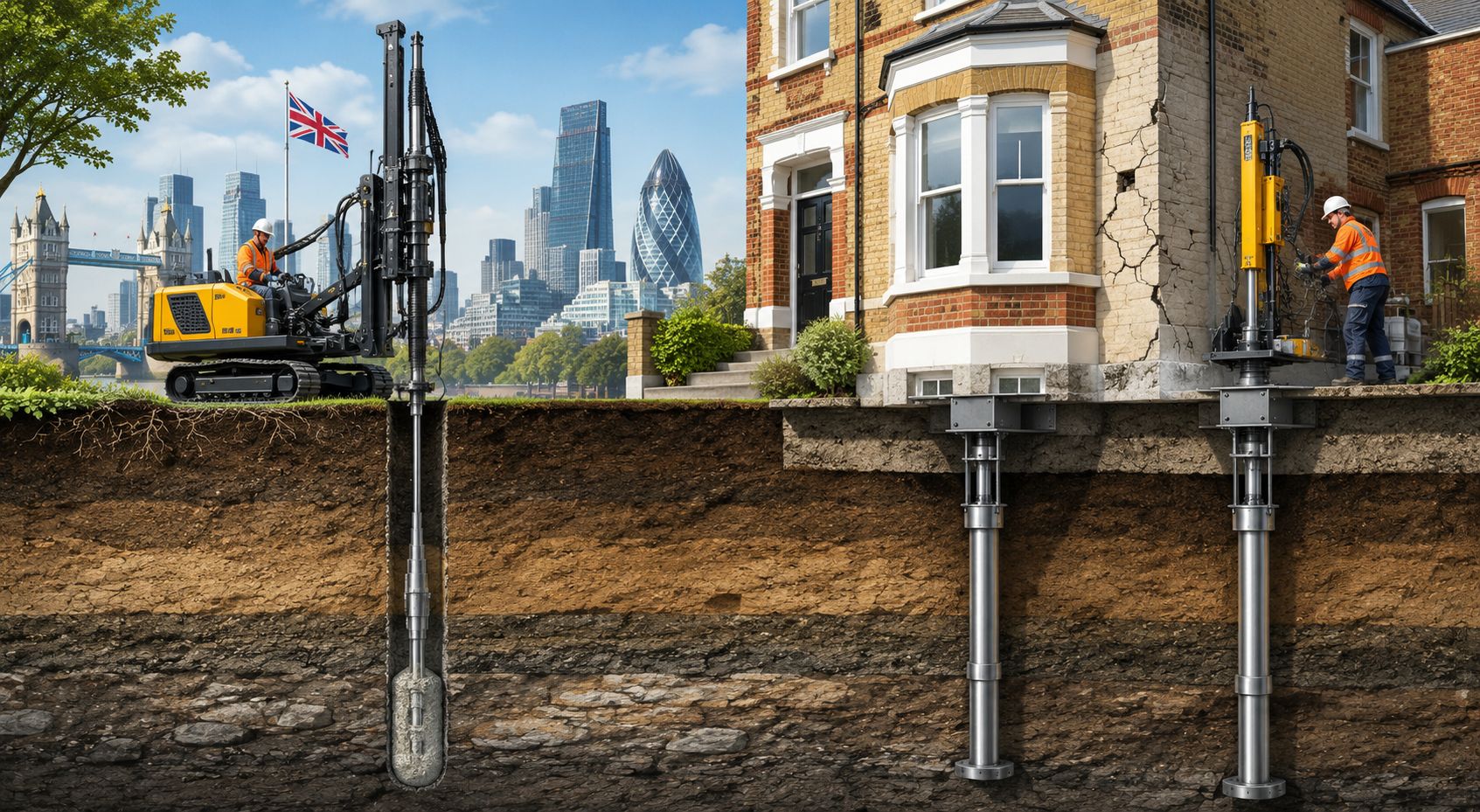
The first signs of structural movement often appear in walls, floors and openings. Cracks widen, doors begin to stick, windows distort and parts of a property may settle unevenly. In some cases, shallow ground improvement may be enough to restore support. In others, the issue requires a deeper structural solution capable of transferring loads beyond weak or variable near-surface soils. This is where push piers, also referred to in specialist ground engineering as driven or pressure-installed micropiles, become particularly relevant.
The principle is straightforward. If the upper ground cannot provide stable support, the load path must be redirected into more competent strata below. Micropiles can provide that deeper support when settlement is significant, ongoing or linked to weak soils, uncontrolled fill, restricted access, low headroom or the need to reduce vibration, noise and disruption.
When micropiles are needed
Not all structural movement justifies a deep foundation solution. Many settlement cases can be addressed through controlled ground improvement when the problem is localised, shallow or related to a loss of support beneath an otherwise adequate foundation. However, micropiles may be considered when the ground requires a more robust load-transfer route or when conventional piling is difficult to carry out.
GEOSEC Ground Engineering’s Groundfix system is based on the controlled installation of modular steel micropiles driven into the ground by continuous hydraulic pressure. Rather than relying on large piling rigs, percussion or heavy vibration, the system uses compact hydraulic equipment to advance each element progressively until the required resistance is achieved.
This method can be useful in occupied buildings, urban sites, rehabilitation works and sensitive environments. Groundfix micropiles are suited to areas where access is limited, working height is restricted or conventional piling could create excessive spoil, vibration or operational disruption. In these situations, the question is not only whether deeper support is needed, but how it can be provided with the least possible impact on the building and its surroundings.
A controlled approach to deeper support
In engineering terms, the value of micropiles is not only that they reach deeper ground, but that they can be installed in a controlled and traceable way. Each installation is associated with monitored hydraulic pressure, providing a record linked to the design resistance required. That traceability matters when surveyors, insurers, engineers, loss adjusters and property owners need confidence that the intervention has been carried out with measurable control.
Micropiles are not, however, a one-size-fits-all answer. Their relevance depends on diagnosis. The choice between shallow ground improvement and a deeper solution using micropiles should be guided by the actual mechanism of movement, the supporting ground, the foundation type, the load path and the constraints of the site. A technical assessment helps determine whether the problem can be addressed near the surface or whether deeper load transfer is necessary.
Applications beyond residential subsidence
Although micropiles are often discussed in relation to residential subsidence, their usefulness extends further. They can be relevant in rehabilitation works, new construction, lift shaft foundations, pool structures and constrained projects where deeper and more controlled support is required.
For the UK market, the challenge is not only to stop structural movement, but to do so in a way that can be explained, supported and trusted. In that context, micropiles can form part of a wider ground engineering response when deeper foundation support is genuinely needed.